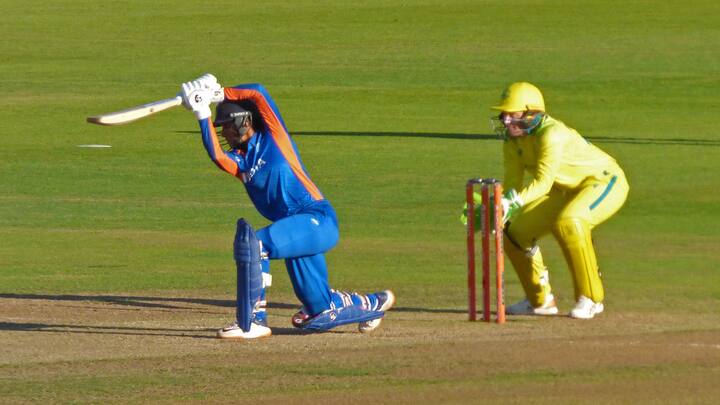
India's record chase in Christchurch leaves a No.3 puzzle over Tilak and Ishan
India began their New Zealand tour with their biggest successful T20I chase. They hunted down 226 at Hagley Oval in Christchurch on Thursday, finishing on 230 for 6 in 19.4 overs. That gave them a four-wicket win and a 1-0 lead in the five-match series. The result was good, but the way India got there has started a debate about their batting order.
New Zealand had been put in to bat and made full use of it. They finished on 225 for 4, with 67 coming off the last five overs. That is the highest T20I total at this ground. All five Indian bowlers went for ten or more an over, so the chase had to be a big one.
It started brilliantly. India reached 94 for 1 in the powerplay, and Sanju Samson brought up his fifty inside those six overs. He went on to make 67 off 33 balls, with eight fours and four sixes. With the required rate under control, the chase looked set to be routine.
Then came the decision that drew most of the attention. Tilak Varma walked in at No.3, and Ishan Kishan did not. Kishan is the world's top-ranked T20I batter and had been occupying that slot. Tilak had been moved down the order in recent times, and the call looked odd given that Mitchell Santner and Michael Bracewell were both bowling spin. Tilak struggled against the slow bowlers and was out for 6 off 11 balls, bowled out by Bracewell. Kishan, who had been held back, then made just 1 off 3 balls. India slid to 122 for 4 and the required rate began to climb again. Fans and analysts questioned why a settled order was changed in the middle of a big chase. The team management has not offered a public explanation yet.
The repair work came from the middle order. Shreyas Iyer, captaining the side in this series, made 42. Axar Patel was promoted to No.6 and hit 24 off 14 balls. The two added 45 in 24 balls for the fifth wicket. That stand took the pressure off the spinners' grip on the game. When Iyer was dismissed, India still needed 16 off 11 balls. Naman Dhir then finished the job at the crease, helped briefly by Nitish Kumar Reddy.
The numbers show why the No.3 call is a fair talking point. Tilak has 657 runs in 22 innings at No.3 in T20Is, at an average of 41.06 and a strike rate of about 148. At No.5 he has 451 runs in 19 innings, at 37.58 and 146.90. Those figures include two hundreds at No.3, though. Take those away and his record there drops to 430 runs in 20 innings at an average of 26.87. So the position suits him, but the matchup against spin that day was a separate problem.
For India, the lesson is a simple one. A flexible batting order is a sound idea on paper, and the team management has favoured it. But the cost showed up when two wickets fell cheaply in a chase that looked controlled. India got through because the openers set a big platform and Iyer and Axar steadied things. A tighter target or a better bowling day for New Zealand might have punished the experiment.
The bowling is the other worry. Giving up 225 on a surface that, by the end, looked flatter than it had earlier is something the team will want to fix quickly. New Zealand's batters are in form and will want to reuse this pitch.
The second T20I is at the same ground on Saturday, October 24, starting at 12:30 PM IST. The series then moves to Wellington, Auckland and Hamilton, before five ODIs from November 4 and two Tests. Expect Kishan back at No.3, or a clear explanation if he is not. India will also want a better showing from their bowlers.